https://tpagency.com/careers/

https://tpagency.com/careers/
AI Ragebait via music – to get us outraged and upset, used for political control


And why Section 230 won’t help them this time


‛The media control how we understand and connect with the world.’ To what extent do you agree with this statement? [30]
First off.
Don’t let the question intimidate you!
Without even thinking about what we’ve studied...what do you think?
Err …you’ve got to be thinking, “Yep, it ‘controls’ a heck of a lot about what ‘we understand’ and how ‘we connect’ with the world.”
Then the answer is, “explain why you think that… and if you can use some key concepts, terms, contexts, examples & theorists we’ve taught you even better!” (Answers below…)
Then…read the last sentence again really carefully:
“To what extent do you agree with this statement?”
So…’to what extent,’ means it’s about a thoughtful balanced argument on both sides, but feel free to have a strong opinion one way or the other.
Or…
You can use you own media consumption as case studies.
And…your learning from other subjects.
We love to learn new stuff.

Media language has changed radically from legacy media to new media.
Audience, Representation, Industry, Language
The tone, style, content, codes, conventions have changed as new media forms are rolled out. New media is consumed in a radically different way passive audience to interactive audience. The audience are also digital poachers and use their cognitive surplus to like, share, mashup, participate and invent new codes, signs, symbols, signifiers that only fans can understand.
Participatory media, engagement, tribes, linear consumption to interactive consumption, new media forms, prosumers, identity and tribalism.
Shirky, Jenkins, Gauntlett & Postman.
“Explain how new media technologies have had an impact on the codes and conventions of media texts.”
Signifiers in media texts which signify ideas & stimulate emotional responses.
A signifier = a unit of meaning: a man, a low brimmed hat, low-key lighting, a wide shot, eerie whistling, cut to a cat rubbing up against the man’s ankle. Individually separately mean very little, but combine the codes you have…meaning and representation.
The ideas and values about a person, place, event… encoded in a media text, which communicates an ideology, whether that be mainstream, counter cultural or personal.

Once upon a time… Baby Boomers and Gen X all received similar message because their choices were so narrow and they passively consumed the media that was broadcast. You might suggest that these generations had much greater sense of their identity, as they lived in traditional communities which were defined for them by a few media channels
In the UK we had 3 TV Channels until 1982, when Channel 4 was launched. So, 4 channels!
Now… Millennials and Gen Z exist within a technologically converged and democratised media ecology, including influencers and pundits, and literally million upon millions of competing representations.
You might argue that representation is now a contested space (a culture war) and that competing (media) language and representations are more diverse and fragmented than ever!
Baudrillard, one of our postmodern theorist, argued that:
“…we live in a world where there is more and more information, and less and less meaning.” He was do much of his writing in the 1960s – 1990s. He died in 2007!
With the advent of fandom, tribes and democratised distribution representation is as broad as it is wide. We’re all journalists now! So, we have a multitude of representations, interpretations, ideas and voices all trying to grab attention.
We have created factions and fandoms but also brought people together.
There is a universality to the image and the meaning encoded. Perhaps the hieroglyph / emoji / meme is the new ‘language.’


EVERYONE REGARDLESS OF AGE, SEX, RELIGION TAKE PART IN THESE RITUALS – THE DANCING CRAZES…EVEN TV ADVERTISING WE BUY ANY CAR.COM RECENT ADVERT HAS ONE OF THE TIK TOK DANCE CRAZES ON IT – it means so much more to those who are culturally competent and ‘get’ the intertextual reference.
All of them…including gender, race, age, social class, power & status, nationality, ability and disability, ethnicity… see Gauntlett & Lynx ads
Reality TV is new media form which employs cross media convergence and synergy. It has become a dominant and highly profitable format which dominates TV schedules and the online space. (Hesmondhalgh).
This format masquerades as reality, but it is merely a RE-PRESENTATION of reality. It is mediated through a producer and an editor and then our own cultural situation & competence (Hall). Everything we did in Postmodern Media

In what ways is the media an extension of ourselves?
Audience, Representation, Industry, Language
The medium is the message. Sort the signal from the noise.
The media we have created has changed what it means to be a human being. We are evolving synergistically with the technology that we create, and our lives are more and more technologically dependent and determined.
Technology, new media, legacy media, superpowers (omniscience, omnipresence, omnipotent…), participatory, always on, always engaging & evolution.
Postman and McLuhan
“Analyse the significance of the convergence of the smartphone with mass communication technology.”
`We become what we behold. We shape our tools and thereafter our tools shape us.’ McLuhan
To understand this, is to understand much of Media Ecology!
Media that existed prior to the internet, including print, radio, and broadcast television.
Communication of content that uses digital distribution such as the internet.

Explore the evolution of media and the impact (superpowers) these new media tools have offered humankind.

Using the printed copies annotate the images.
Add callouts at each stage of the evolution of humankind and describe what new powers and abilities each stage has given to society, culture and the individual.
In essence, ‘How has each stage of new media technology acted as an, ‘Extension of humanity?’ To coin a phrase from Marshall McLuhan.
Help your teacher to create a list on the board for as many advantages and disadvantages for society pre 1990 and post 1990 (the advent of the internet) in terms of what and how media operated. You may have to interrogate your teacher. For example, how did they organise their social life? How did they listen to music?
Some suggestions are linked in here.
We already come across AI on a daily basis:
But what is the metaverse? We have gone from Web 1.0 (a digital screen that you read but couldn’t interact with) to Web 2.0 that became participatory through a screen and Web 3.0 will take us through to the Metaverse – instead of interacting through the screen, we will be inside the screen.
Don’t think that will ever happen? Well, only a few years ago, we would never have believed we could have spoken face to face, to Aunty Beryl in New Zealand whilst on a bus in Bognor. The magic is ongoing.
The real problems arising are: security, addiction, safety and of course – how reality will be impacted – what indeed, will be reality?
Will the representation of reality, become more real than other interactions and experiences?

To understand what is meant by ‘Attention’ or ‘Surveillance’ Capitalism.
Audience, Representation, Industry, Language
The ways in which social media makes money is by selling their audiences’ attention. Remember, ‘If the product is free, you are the product!’ What does this mean for the ways in which social media (industry) uses media language and representations to attract and engage the audiences’ attention?
Attention economy, advertising model, algorithm, gatekeepers, click bait, alarmist content, dopamine, monetisation and mental health.
Pariser, Haidt, Gauntlett, Two-Step Flow Model, Postman
“Explain why people’s personal data is so valuable to media companies.”
How many ways do you think Google can track your browsing and what kind of information might they be gathering from us. With a partner, list as many as you can and then share them with the class.
Apparently, Google alone ‘harvests’ thousands of pieces of info about us from using Google search and Google apps. That is phenomenal. ….can we do something about this?
But, could we actually be complicit in our acceptance of tracking, data surveillance? Is it just something we have come to accept and not challenge?

The panopticon was a prison designed by Jeremy Bentham, in which any prisoner in a gaol could be observed by a prison guard secretly at any given time without the prisoner’s knowledge. The prisoner would therefore police themselves, as they were constantly under the assumption that an authority figure might be spying on them at any time, a bit like God if you think about it! This oppressive and authoritarian system is NOTHING compared to the surveillance economy in which our every click, view, movement, relationship, purchase, opinion…is being watch and scrutinised by a tech giant, whose agenda does not necessarily align with our best interests. These tech giants are conglomerates who will sell our data to other companies in order to sell us stuff and political parties who can use the data to influence our vote. In authoritarian regimes this data can be used to ensure the citizens remains loyal and do not challenge the status quo!
Is anyone prepared to share their browsing history with the class? No, probably not. But we seem happy to be tracked by complete strangers in far off countries. Moreover, we give these people (& their algorithms) permission to analyse that data in order to learn our preferences and triggers in order to shape our media consumption and effect our behaviour and ideologies.
Why is that I wonder? Seems like a cognitive dissonance!
To track or not to track – that is the question!
With a partner – sum up what it is saying about our lives living in the shadow of continual data surveillance on our favourite converged technology device.
A couple of years ago there was a story (a really important case study) which revealed, for the first time, just how devious and manipulative social media data is monetised and used to shape our values, attitudes, beliefs and most importantly voting behaviours!

What do you think about your time and attention being monetised?
How do you feel about Facebook monetising your data, by selling your data to advertisers and political groups so that they can influence you more effectively?
That’s why we have data protection and a right to be forgotten.
Even though we are not part of the EU, the GDPR (General Data Protection Regulation) still applies.
Is the pendulum swinging already? Are users tired of meaningless content. Are they trying to cut down their screen time? Are they suspicious of content being AI?
We could be leaving the Attention Economy and moving into the Intention Economy. People want nourishing not empty content. Click on the link.


To understand some of the concerns that people hold about how social media is having on society and the well-being of young people.
Audience, Representation, Industry, Language
Harm, addiction, bullying, offense, cancelled, rewiring of childhood, validation, dopamine, influence & mimetic models of desire.
Haidt
“Analyse the significance of the convergence of the smartphone with mass communication technology.”
Jonathan Haidt discusses his new book, ‘The Anxious Generation: How the Great Rewiring of Childhood Is Causing an Epidemic of Mental Illness’.
This is a link to a really useful short article – some great facts and stats that you could use.
As well as calling for school phone bans, Haidt argues that governments should legally assert that tech companies have a duty of care to young people, the age of internet adulthood should be raised to 16, and companies forced to institute proper age verification – all eminently sensible and long overdue interventions.
AUSTRALIA have banned social media for under 16’s but is it working?
Trigger warning: Content about suicide.
“This house believes that mobile communication technology, free access to data and information are a fundamental human right and should not be curtailed nor constrained by law, statute, government regulation nor any educational establishment.”

Audience, Representation, Industry, Language
That the media has an effect on an audience is without doubt.
There are various competing theories, which try to explain the effect media has on audiences, these are called, ‘Effects Theories.’
From propaganda to couch potatoes and from the two-step flow model to cultivation theory, how are our identity and ideology shaped and how are we persuaded by the media we consume?
Media effects, propaganda and persuasion, influence(r), desire, advertising, ideology, passive audiences, hypodermic syringe (copy cat behaviour), cultivation, mean world theory.
Bandura (discredited in Media Studies), Two Step Flow (Lazarsfeld) & Gerbner
“‛The media control how we understand and connect with the world.’ To what extent do you agree with this statement?”
“‘Digital technology has had a significant impact on the representation of public and private lives.’ To what extent do you agree with this statement?”
‘Evaluate the significance of contemporary technologies which have changed our relationship with the media.’ (audiences, public and private / ownership / globalisation / convergence)
“Advertising exists to create desire.”
So, does advertising work on you or are you too savvy and immune to its influence?


There is a widely held assumption that the media and advertising in particular (including propaganda) has an influence on the audience, so much so that they act based on an advert. Whether that is to buy a particular brand or radically change their behaviour, in the propaganda examples above, join the army and fight in the trenches during World War 1 or contribute the the war effort at home.
Media Studies asks a simple question, which has proven remarkably hard to answer conclusively:
To what degree can we say that media has an effect on the audiences’ behaviours, attitudes, values and beliefs about the world?
If it does effect behaviours and ideologies, how?
There are two broad schools of thought when thinking about media effects on audience.

Essentially this study suggests that…monkey see, monkey do…

This idea is reinforced regularly, ironically by newspapers, who suggests that violent and anti social behaviour is copied by a thoughtless, easily manipulated audience. What the audience sees in the media they simply copy in terms of their behaviour and ideologies. A famous experiment by Bandura called the Bobo Doll experiment suggested that children will copy the behaviour of adults they watch playing a toy doll roughly and aggressively. Bandura suggested that this copy cat behaviour can be applied to audiences consuming the media just as easily.
“‘Ok,’ you may say. I’ve seen hundreds, if not thousands, of acts of violence in the media and I’ve never done anything violent. In fact society is in many ways less violent than it has ever been!”
An adaptation of the hypodermic syringe model, which suggests that, ‘…most people form their opinions under the influence of opinion leaders (influencers), who in turn are influenced by the mass media.’ Wikipedia
These opinion leaders might be…
View this post on Instagram
Journalists, pundits, influencers, sports stars, singers, film stars, shock jocks…
This is Alex Jones an American shock jock, who has a large, loyal and varied following around the world.
Although, an American judge recently, “ordered right-wing conspiracy theorist Alex Jones to pay an additional $473 million in punitive damages over “lies” he told about the 2012 Sandy Hook Elementary School shooting.” and , CNN
A lot of people look up to this man and consider him to be a victim of a deep state conspiracy who are out to suppress the truth about the corruption at the heart of the establishment.
That’s the two step flow model right there!
Gerbner would suggest that our perceptions of what the world is like have been distorted by what we constantly see in the media over time.
Consider the following hypothetical example:

Audience, Representation, Industry, Language
That the media has an effect on an audience is without doubt.
There are completing theories, which try to explain how this this effect might work.
The audience are more engaged, thinking and active agents in the media they consume. Audience ideologies shape consumption of media texts and audiences use media to shape and express their identity.
Active audience, reception theory, (preferred, negotiated & oppositional readings), ideology, identity, participation and engagement.
Hall, Gauntlett, Blumler & Katz,
“‘Digital technology has had a significant impact on the representation of public and private lives.’ To what extent do you agree with this statement?”
“The media control how we understand and connect with the world.’ To what extent do you agree with this statement? “(audiences, changing modes of reception, convergence, representation, media language, technology, ownership) [30]
‘Evaluate the significance of contemporary technologies which have changed our relationship with the media.’ (audiences, public and private / ownership / globalisation / convergence)
Media can impact on us in several different ways, where there is no doubt, is that it is impactful!
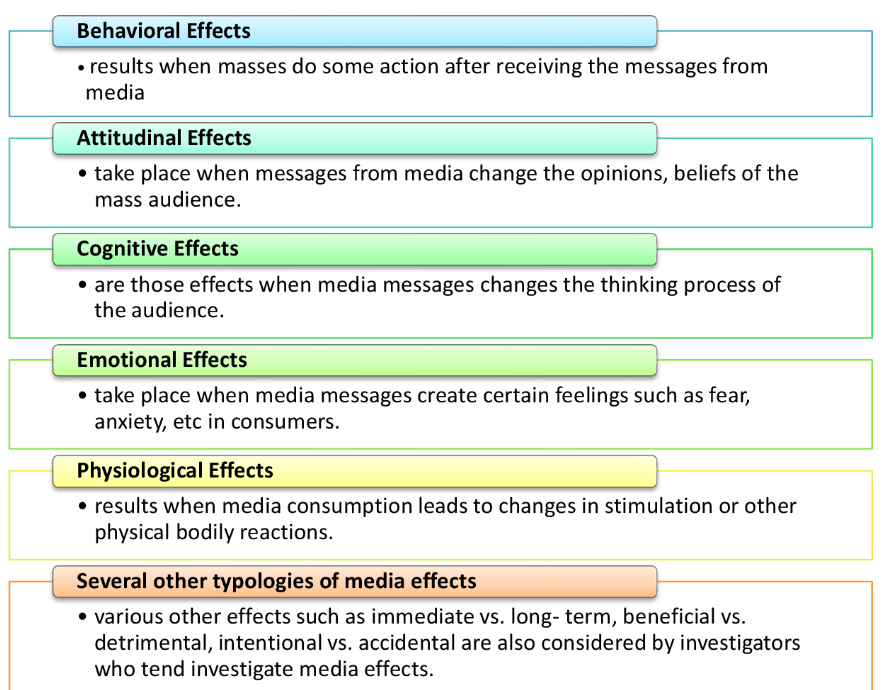
An alternative set of assumptions is that the audience are more cognizant and discerning. Furthermore, we need to consider a whole range of factors working on the individual which might shape their response to media texts.
“An active audience engages, interprets and responds to a media text in different ways and is capable of challenging the ideas encoded in it. A passive audience is more likely to accept the messages encoded in a media text without challenge and are therefore more likely to be directly affected by the messages.” BBC Bitesize
Blumler and Katz, suggest that audiences are more active in seeking out function and pleasure from media texts and that we should think about what they are seeking from any given text and how they use the media in other aspects of their lives:
Stuart Hall, suggests that the relationship between the messages and connotation embedded in a media text and the ideology of the audience are essential in understanding the ways in which an audience respond to a text.
Remember ideology is defined as the values, attitudes and beliefs that any given person holds to be true.
Hall suggests that a audience reading can be described as:
David Gauntlett argued our heavy exposure to the media could, “hardly fail to affect our own way of conducting ourselves and our expectations of other people’s behaviour.”
So, in many ways Gauntlett is suggesting that the effect of Media is even more profound than changing our behaviour or attitudes. That the media in many ways has a huge impact on our out sense of who we are and how we operate in the world (our identity).
He, like Jenkins, suggests that audiences now have the digital tools to, ‘express and connect and create in ways we didn’t have before and which can help people shape creative identities.’ Moreover, that, ‘social media is part of conversation which can help us, ‘think about ourselves and how we are in the world…that’s what identity is‘
“… identity is this thing you construct for yourself but at the same time there’s all of these ‘representations’ [sic] coming at you. There’s all the stuff that you can create and make and share as well. So identity has opportunities to be very creative and connecting.”


To understand how the evolving media environment has led to divisions and culture wars in our society.
Audience, Representation, Industry, Language
Social media has led to a fragmented audience and conflicting representations of the world.
Tribalism, culture wars, polarisation, democracy, prosumer, cognitive surplus, influencer, the two-step-flow model, participatory media
Postman, McLuhan, Gauntlett, Shirky & Jenkins
“‘Digital technology has had a significant impact on the representation of public and private lives.’ To what extent do you agree with this statement?”
An online tribe is a virtual community formed around shared interests, values, or goals, where members connect and interact through online platforms. These communities transcend geographical boundaries, uniting individuals from diverse backgrounds within a digital space.
Watch this video and answer the questions on this document (TBC).
In small groups consider the following questions, nominate a scribe to make notes.
Alternatively this could be done on a shared document / slideshow.
In pairs read through the articles below. Take one each.

Note: We understand that this is a difficult debate and there are strong feelings and views on both sides. We don’t have time during the lesson, but if you would like to learn more about gender theory and the difference between sex and gender, watch this video featuring Judith Butler.